

Best Engine Oil Buying Guide
| Brands | Models | Oil Grade |
| Bajaj | All Models | 20w 50 |
| Gpx Demon | All Models | 10w 40 |
| KTM | All Models | 20w 50 |
| Hero | All Models | 10w 30 |
| Honda | All Models | 10w 30 |
| Suzuki | All Models | 10w 40 |
| Taro GP | All Models | 10w 40 |
| TVS | All Models | 10w 30 |
| Lifan | All Models | 10w 40 |
| Yamaha | All Models | 10w 40 |
| Royal Enfield | All Models | *yet to be announced |
| Runner | All Models | 20w 50 |
Does Engine Oil Grade Matter?
The answer is Yes. Engine oil grade does matter a lot. Motorcycle brands conduct extensive R&D to determine the most suitable engine oil grade for their designated bike models. Engine oil grade explains how the engine oil will perform at different temperatures. Engine oil grade is associated with viscosity. Viscosity refers to how much a fluid resists while flowing, in simple words viscosity means thickness. E.g. water has a lower viscosity than sugar syrup thus when we pour water and sugar syrup side-by-side water flow will be much faster as compared to sugar syrup.
For example 20w 40:
Here the W stands for winter. The number before W (20) refers to the viscosity of the engine oil during cold weather. A higher number means, the oil is thicker during cold conditions.
40 refers to the viscosity of the engine oil in high temperatures (100°C or 212F). A higher number like 50 means the oil is thicker and provides better lubrication film at high temperatures, ideal for engines under heavy loads or in hot climates.
Mineral or synthetic which engine oil should you buy:
Choosing the type of engine oil depends on a few factors such as riding style, climate and operating conditions, cost and budget.
Synthetic engine oils are modified chemically. Thus, there is little to no variation in its molecules. As the molecules are consistent, synthetic engine oils are chemically more stable as compared to mineral engine oils. During heavy and extreme usage, synthetic engine oil performs better. As a result, if you are a performance-oriented biker with high revving and heavy usage, synthetic engine oil should perform better for you.
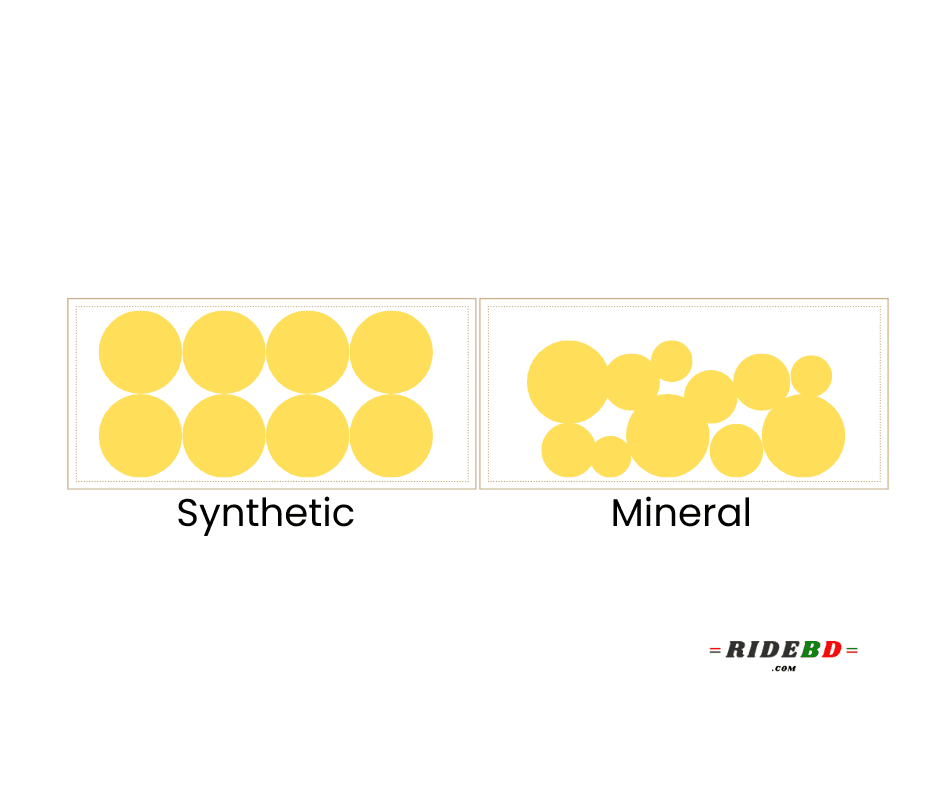
On the other hand, mineral engine oil is a refined form of naturally developed crude oil. Thus, the molecules are inconsistent and break down under high heat. Mineral engine oil is suggested for daily commuting and steady riding style. Mineral engine oil is relatively cheaper than synthetic engine oil. However, mineral engine oil has a shorter lifespan and requires frequent oil changes.
Conclusion: To sum up, selecting the grade and the type of engine oil—regardless of whether it is mineral or synthetic oil—is not simply an option; it is one of the very necessary considerations to sustain the performance and the life of your motorcycle. It is also very important to consider the engine oil brand as well. The way you ride, the weather conditions you ride in, and even the specifications of your particular motorcycle make all the difference. With the right selection of oil grade and type, you will enjoy better rides, optimize engine performance, and prolong the engine parts. Just like any other machine, your motorcycle engine will also last longer and work even more efficiently when you treat it well.